
The Limits of Static Identity Verification
Traditional Know Your Customer (KYC) protocols serve as a necessary gatekeeper, verifying the identity of users at the point of onboarding. However, this verification is inherently static. It establishes who a user is at a single moment in time but provides no visibility into their subsequent financial behavior. Once funds are deposited into a cryptocurrency wallet, the KYC process effectively ends, leaving a significant gap in compliance coverage.
This static nature creates a blind spot for illicit activity. Criminal actors can use verified identities to deposit funds and then immediately move them through complex transaction chains. Because KYC does not monitor these post-onboarding flows, regulators and exchanges cannot detect if those funds are linked to sanctions lists, darknet markets, or money laundering networks. The identity remains verified, but the risk profile of the associated assets becomes unknown.
Regulatory frameworks, including the Financial Action Task Force (FATF) Travel Rule, increasingly recognize this limitation. The FATF emphasizes that compliance must extend beyond initial identification to include ongoing monitoring of transactions. Without continuous visibility, financial institutions remain exposed to regulatory penalties and reputational damage, as they cannot demonstrate due diligence for funds that have already moved on-chain.
The failure of static KYC to track asset movement necessitates a shift toward dynamic monitoring. While KYC answers "who," it fails to answer "where" or "how" funds are being used. This disconnect underscores the urgent need for real-time solutions that can analyze blockchain data as transactions occur, providing the continuous oversight that static identity checks simply cannot provide.
How KYT graph analysis works
Traditional KYC verifies identity at onboarding, but it does not monitor activity. KYT graph analysis fills this gap by examining the ledger itself. It maps transactions between wallets, revealing patterns that static identity checks miss. This approach treats blockchain data as a dynamic network rather than a series of isolated events.
The process relies on three core mechanisms: transaction tracing, clustering, and risk scoring. Each step builds on the previous one to provide a continuous compliance view.
Transaction tracing
KYT tools follow the flow of funds across multiple hops. When a wallet interacts with a known entity, such as a centralized exchange or a mixer, the system flags the connection. This tracing capability allows compliance teams to identify the origin and destination of assets in real time. It is particularly useful for detecting layering techniques used in money laundering.
Clustering
Not every wallet is owned by a single person. Clustering algorithms group addresses that likely belong to the same entity. By linking these addresses, KYT systems create a unified profile of an actor’s total activity. This prevents users from obscuring their footprint by splitting funds across multiple addresses. Clustering ensures that compliance decisions are based on the true volume and nature of interactions.
Risk scoring
Once transactions are traced and identities are clustered, the system assigns a risk score. This score reflects the likelihood that the activity involves illicit funds. High-risk scores trigger alerts for further investigation. The scoring model updates dynamically as new transactions occur, ensuring that the risk assessment remains current. This continuous monitoring is what distinguishes KYT from the static nature of KYC.
The combination of these elements creates a robust defense against financial crime. While KYC provides the initial identity check, KYT graph analysis offers ongoing scrutiny. This dual approach is essential for institutions operating in high-stakes regulatory environments.
KYC versus KYT graph comparison
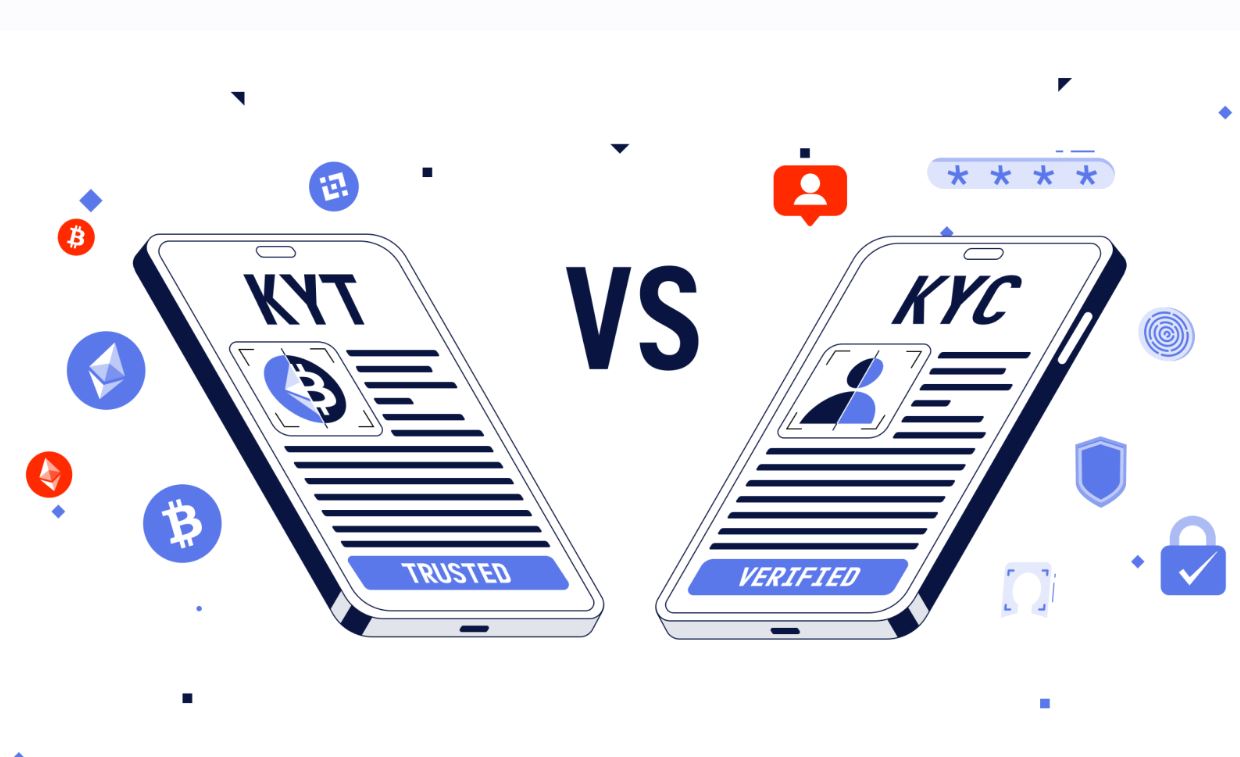
Traditional Know Your Customer (KYC) protocols rely on static, point-in-time identity verification. While necessary for onboarding, this approach creates a compliance blind spot once the customer relationship is established. In contrast, Know Your Transaction (KYT) graph analytics provide continuous, real-time monitoring of blockchain activity, addressing the limitations of static data with dynamic risk assessment.
The following table outlines the operational differences between these two compliance frameworks. KYC establishes the baseline identity, whereas KYT graph analysis detects illicit patterns across the transactional network.
| Dimension | Traditional KYC | KYT Graph Analytics |
|---|---|---|
| Timing | Static (onboarding only) | Real-time (continuous) |
| Data Scope | Identity documents and PII | On-chain transaction history |
| Detection | Cannot detect post-onboarding risk | Identifies laundering patterns |
| Regulatory Focus | Customer identification programs (CIP) | Transaction monitoring and SARs |
KYC remains a regulatory requirement for verifying who the customer is. However, KYT graph technology is increasingly viewed as essential for maintaining compliance with anti-money laundering (AML) standards. By mapping fund flows and identifying high-risk counterparties, KYT graphs allow institutions to react to threats as they emerge rather than retrospectively.
While KYC provides the foundational identity layer, KYT graph analytics offer the necessary visibility into the movement of assets. Effective compliance strategies integrate both: KYC for initial screening and KYT for ongoing surveillance.
When to use KYT graph analytics
KYT graph analytics are essential when static verification is insufficient to manage real-time risk. While traditional KYC establishes identity at onboarding, it does not monitor the flow of funds. Graph analysis provides the dynamic visibility required to detect illicit activity as it happens, rather than after the fact.
Sanctions screening and entity mapping
Regulatory frameworks require financial institutions to screen parties against global sanctions lists. Graph analytics extend this screening beyond direct counterparties to identify indirect exposures. By mapping relationships between wallets and entities, compliance teams can detect layered attempts to obscure beneficial ownership.
This capability is critical for adhering to directives from bodies like the Financial Action Task Force (FATF). Graph tools visualize complex networks, allowing analysts to trace funds through multiple hops to identify hidden connections to sanctioned jurisdictions or entities.
AML transaction monitoring
Anti-money laundering (AML) monitoring relies on detecting patterns indicative of structuring, smurfing, or rapid movement of funds. Graph analytics excel at identifying these behavioral anomalies by analyzing the topology of transactions. Instead of flagging isolated transfers, the system evaluates the context of a transaction within the broader network.
This approach reduces false positives compared to rule-based systems. By understanding the flow of value, institutions can distinguish between legitimate high-volume activity and suspicious clustering that suggests money laundering operations.
Exchange and service provider compliance
Centralized exchanges and cryptocurrency service providers face increasing regulatory pressure to implement robust transaction monitoring. KYT graph analytics provide the necessary infrastructure to comply with evolving standards, such as the EU’s Markets in Crypto-Assets (MiCA) regulation.
These tools enable exchanges to maintain audit trails and respond to law enforcement requests with accurate transaction histories. The visual nature of graph data simplifies the explanation of complex fund flows to regulators, ensuring transparency and accountability in compliance reporting.
Building a compliant KYT graph strategy
Integrating Know Your Transaction (KYT) graph analytics into existing compliance workflows requires shifting from static identity verification to dynamic behavior monitoring. Traditional Know Your Customer (KYC) checks provide a snapshot of who a user is, but they lack visibility into how funds move through decentralized networks. A KYT graph strategy fills this gap by mapping transactional relationships in real time, allowing compliance teams to identify high-risk clusters and suspicious patterns before they escalate.
To align with regulatory expectations, institutions must prioritize data quality and source integrity. Graph analytics rely on accurate on-chain data feeds; incomplete or delayed information can lead to false positives or missed sanctions violations. Compliance teams should validate that their graph tools integrate directly with official sanction lists and regulatory guidance, such as those issued by the Financial Action Task Force (FATF), to ensure that risk scoring reflects current legal standards rather than historical assumptions.
Implementation should begin with a phased approach. Start by overlaying graph analytics on high-volume or high-risk transaction streams to test detection accuracy. Use these insights to refine risk thresholds and adjust monitoring rules iteratively. This method ensures that the KYT graph complements, rather than disrupts, established KYC procedures, creating a layered defense that satisfies both operational efficiency and regulatory scrutiny.
No comments yet. Be the first to share your thoughts!