
The 2026 compliance landscape
By 2026, the regulatory framework for digital assets has shifted decisively from reactive reporting to proactive transaction monitoring. Know Your Transaction (KYT) is no longer an optional layer but a foundational pillar of Anti-Money Laundering (AML) compliance, operating in tandem with Know Your Customer (KYC) requirements. Regulators worldwide are closing loopholes that previously allowed illicit funds to move through decentralized finance (DeFi) protocols and cross-border exchanges with minimal oversight.
The Financial Action Task Force (FATF) continues to set the global standard, emphasizing that virtual asset service providers (VASPs) must monitor transactions in real time to detect suspicious patterns before they settle. This shift demands infrastructure capable of analyzing blockchain data at the speed of the network, rather than relying on batch processing or post-transaction audits. Failure to implement robust KYT systems now exposes institutions to significant regulatory penalties, asset freezes, and reputational damage.
This environment requires a rigorous approach to risk assessment. Compliance officers must integrate KYT solutions that can trace fund origins, identify mixing services, and flag interactions with sanctioned addresses instantly. The goal is to create a transparent audit trail that satisfies both domestic regulators and international bodies, ensuring that the integrity of the financial system is maintained in an increasingly complex digital economy.
How graph analytics detect illicit flows
Traditional compliance systems rely on linear, rule-based ledgers that flag transactions based on static thresholds. These systems struggle with complex money laundering schemes where funds are moved through dozens of intermediate wallets to obscure their origin. A single transaction might appear clean in isolation, but when viewed as part of a larger network, the pattern reveals itself. Graph analytics shifts the focus from individual transactions to the relationships between entities, allowing compliance teams to trace the flow of assets across entire networks rather than isolated points.
In a graph database, every wallet address is a node, and every transfer is an edge. This structure allows for multi-hop analysis, which can identify clusters of addresses that interact frequently but share no direct link to a known illicit entity. For example, a "mixer" service might not be explicitly blacklisted, but its position in the network—connecting hundreds of unverified wallets to a few high-risk exchanges—signals its function. By analyzing the topology of these connections, compliance tools can detect layering and integration stages of money laundering that linear databases miss entirely.
This approach is particularly effective against structuring, where criminals break large sums into smaller, unreportable transactions. In a graph, these small transactions form a dense cluster around a central node. Instead of flagging each small transfer individually, the graph identifies the cluster as a single suspicious entity. This reduces false positives and allows investigators to focus on the underlying network structure rather than chasing individual, low-value transactions.
The visual representation of these networks helps investigators understand the scale and scope of potential violations. By overlaying risk scores on nodes, compliance teams can prioritize high-risk areas of the graph for deeper investigation. This method aligns with the evolving expectations of regulators, who increasingly demand a holistic view of financial flows. As noted by the Financial Action Task Force (FATF), emerging technologies like graph analytics offer significant potential for improving the detection of complex financial crimes when integrated into robust compliance frameworks.
Real-time screening against sanctions lists
Compliance infrastructure must intercept prohibited transfers before they settle. Real-time KYT systems integrate directly with OFAC, UN, and EU sanctions lists to create an immediate barrier against illicit finance. Unlike traditional batch processing, which leaves a window for funds to move, graph-based screening evaluates each transaction against global watchlists at the moment of initiation.
The integration requires matching sender and receiver data against dynamic lists that change frequently. The system flags potential matches instantly, allowing compliance teams to review and block transactions associated with sanctioned entities. This reduces the risk of regulatory penalties and prevents the network from being used for money laundering or terrorism financing.
To demonstrate the operational difference, the table below compares traditional batch screening with real-time graph-based screening.
| Feature | Traditional Batch | Real-Time Graph |
|---|---|---|
| Latency | Hours to days | Milliseconds |
| False Positives | High | Low |
| Regulatory Risk | High exposure window | Minimal exposure |
| Data Context | Static snapshot | Dynamic graph |
Top blockchain analytics tools for 2026
Selecting the right KYT Graph provider requires evaluating how well their graph database models track illicit fund flows and adhere to global regulatory standards. The following tools are recognized for their robust compliance outcomes and real-time transaction monitoring capabilities.
Chainalysis
Chainalysis remains a standard in the industry, offering a comprehensive blockchain intelligence platform used by over 4,000 organizations, including major exchanges and law enforcement agencies. Their KYT Graph capabilities provide deep visibility into transaction patterns, enabling compliance teams to identify high-risk entities and generate audit-ready reports for regulatory submissions. The platform’s extensive tag library helps teams classify addresses with precision, reducing false positives and streamlining the screening process.
Elliptic
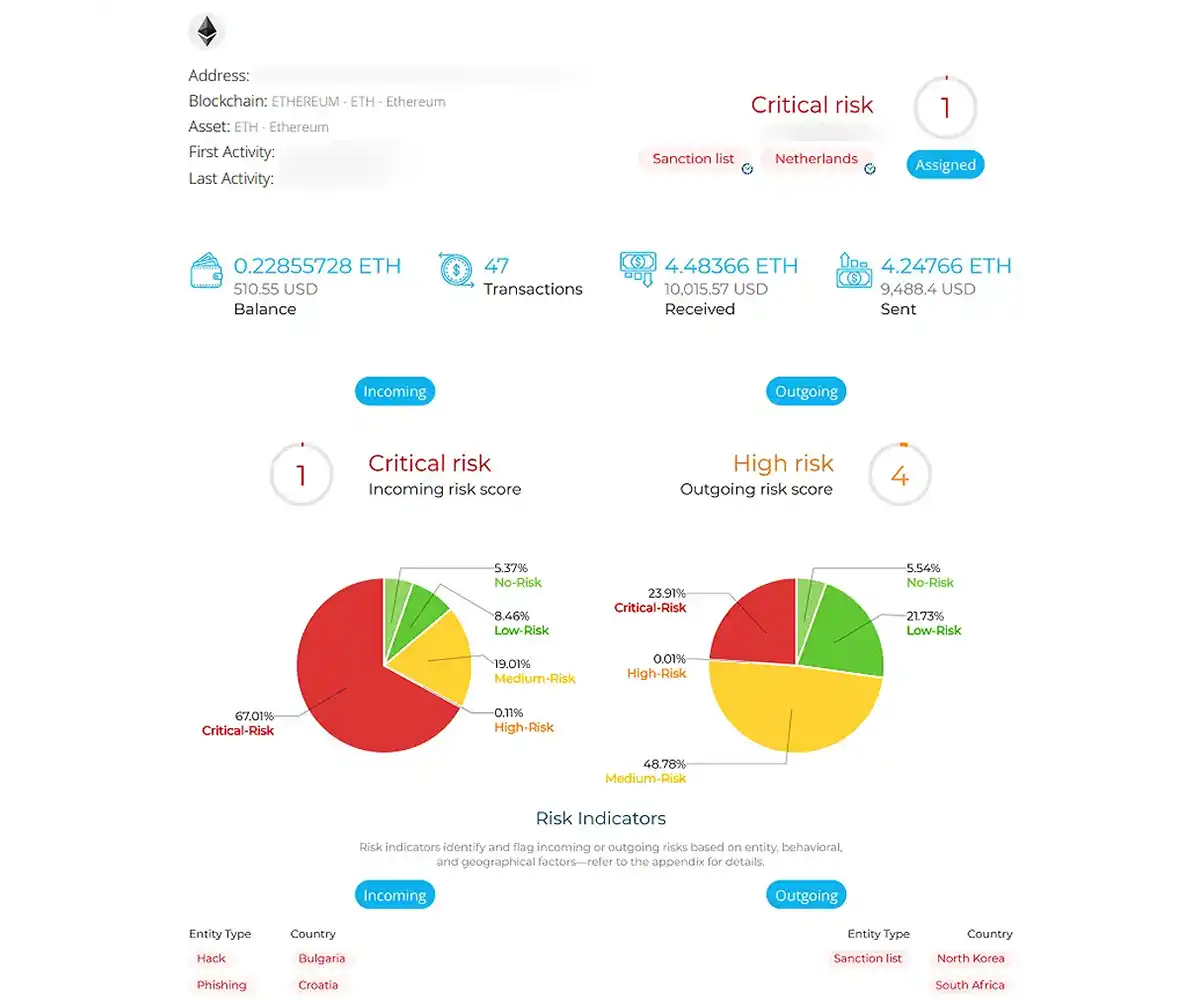
Elliptic specializes in real-time blockchain analytics, focusing on helping financial institutions detect and prevent financial crime. Their solution integrates directly into banking and exchange workflows, providing instant risk scores for incoming transactions. Elliptic’s graph analysis tools are particularly effective at tracing complex money laundering schemes across multiple chains, offering a clear visual representation of fund movements that aids in both compliance reporting and investigative efforts.
Scorechain
Scorechain offers a privacy-focused KYT solution that emphasizes speed and accuracy in transaction screening. Their graph analysis engine is designed to handle high-volume transaction streams, providing instant risk assessments for crypto assets. Scorechain’s platform is widely adopted by exchanges and payment processors for its ability to integrate seamlessly with existing compliance frameworks, ensuring that teams can maintain regulatory adherence without sacrificing operational efficiency.

As an Amazon Associate, we may earn from qualifying purchases.
Implementing AI-driven fraud prevention
Machine learning models enhance graph analytics by identifying novel fraud patterns that static rule-based systems often miss. By analyzing transactional relationships and network structures, these systems detect complex, multi-hop schemes indicative of money laundering or synthetic identity fraud.
Integrating these models into Know Your Transaction (KYT) workflows significantly reduces false positives. Traditional thresholds often flag legitimate high-value transfers, burdening compliance teams with manual reviews. AI-driven approaches contextualize transactions within the broader graph, distinguishing between benign activity and malicious intent with greater precision.
This shift allows financial institutions to focus resources on genuine threats. Regulatory frameworks increasingly expect institutions to demonstrate adaptive monitoring capabilities. Implementing these advanced analytics ensures that compliance programs remain effective against evolving criminal methodologies.
No comments yet. Be the first to share your thoughts!