

KYC limits and KYT graph advantages
Know Your Customer (KYC) protocols have long served as the foundational gatekeeper for financial onboarding. Under guidance from the Financial Action Task Force (FATF), institutions are required to verify the identity of clients before establishing a business relationship. This process typically involves collecting government-issued identification, proof of address, and beneficial ownership data. While essential for initial entry, KYC is inherently static; it captures a snapshot of who the customer is at a single point in time.
This static nature creates a significant blind spot for ongoing compliance. Once a customer is onboarded, traditional KYC does not actively monitor their behavior. It cannot detect if a low-risk individual suddenly begins transacting with high-risk jurisdictions or if their declared source of wealth aligns with their actual transaction volume. The Office of Foreign Assets Control (OFAC) and FinCEN emphasize that customer due diligence is not a one-time event but a continuous obligation. Relying solely on initial verification leaves institutions vulnerable to money laundering and terrorist financing activities that emerge after account opening.
The KYT graph addresses this gap by shifting the focus from identity to activity. Instead of merely checking a box at onboarding, KYT graph analytics continuously map and analyze the flow of funds across the network. By visualizing relationships between entities, the KYT graph can identify complex layering schemes, circular transactions, and connections to sanctioned addresses in real time. This dynamic monitoring allows compliance teams to detect illicit patterns that static KYC data would never reveal.
Note: KYC is a snapshot; KYT is a live feed. Regulatory bodies now require ongoing monitoring, not just initial verification.
The integration of KYT graph technology transforms compliance from a reactive, audit-based function into a proactive defense mechanism. Where KYC asks "Who is this person?", the KYT graph asks "Where is this money going and who is it connected to?" This distinction is critical for meeting the evolving expectations of global regulators who demand not just identity verification, but active surveillance of financial ecosystems to prevent illicit finance.
KYT graph vs KYC: Side-by-Side Compliance Comparison
Regulatory bodies, including the Financial Action Task Force (FATF) and FinCEN, emphasize that identity verification alone is insufficient for modern anti-money laundering (AML) frameworks. While KYC establishes the baseline identity of a customer, the KYT graph provides the necessary context for transactional integrity. The following comparison outlines the distinct operational roles of each mechanism.
| Feature | KYC | KYT Graph |
|---|---|---|
| Verification Timing | Static (onboarding) | Continuous (real-time) |
| Primary Data Source | Identity documents | Blockchain ledger |
| Risk Detection | Pre-transaction | Intra-transaction |
| Regulatory Focus | Customer Due Diligence (CDD) | Transaction Monitoring |
KYC acts as a static snapshot of a customer’s identity, primarily satisfying Customer Due Diligence (CDD) requirements at the point of onboarding. In contrast, the KYT graph operates as a dynamic monitoring layer, analyzing the flow of funds against known illicit addresses in real time. This distinction allows institutions to detect suspicious activity that static identity checks cannot reveal, such as interactions with sanctioned entities or mixing services.
How KYT graph detects illicit flows
A KYT graph operates by mapping the interconnected web of blockchain addresses to identify suspicious activity in real time. Unlike static KYC checks that verify identity at onboarding, KYT analytics continuously monitor transaction histories, clustering addresses based on behavioral patterns and fund flows. This dynamic approach allows compliance teams to detect complex layering techniques used by money launderers before funds are withdrawn or converted.
The system identifies illicit flows by tracing the path of funds from source to destination. When a transaction occurs, the KYT graph analyzes the incoming and outgoing addresses, looking for connections to known bad actors, such as sanctioned entities, mixers, or darknet markets. By visualizing these relationships, investigators can see if a seemingly clean wallet is actually part of a larger network involved in criminal activity.
Clustering addresses is a core function of KYT graph technology. By grouping addresses that share common ownership or transaction patterns, the system can attribute activity to specific entities, even if they use multiple wallets to obfuscate their identity. This clustering helps in identifying shell companies or individuals who attempt to split funds across numerous addresses to avoid detection thresholds.
Flagging interactions with sanctioned entities is another critical capability. The KYT graph cross-references every transaction against updated sanctions lists from OFAC, the UN, and other regulatory bodies. If a wallet interacts with a sanctioned address, the system immediately flags the transaction, allowing compliance officers to freeze assets or file Suspicious Activity Reports (SARs) as required by FinCEN regulations.
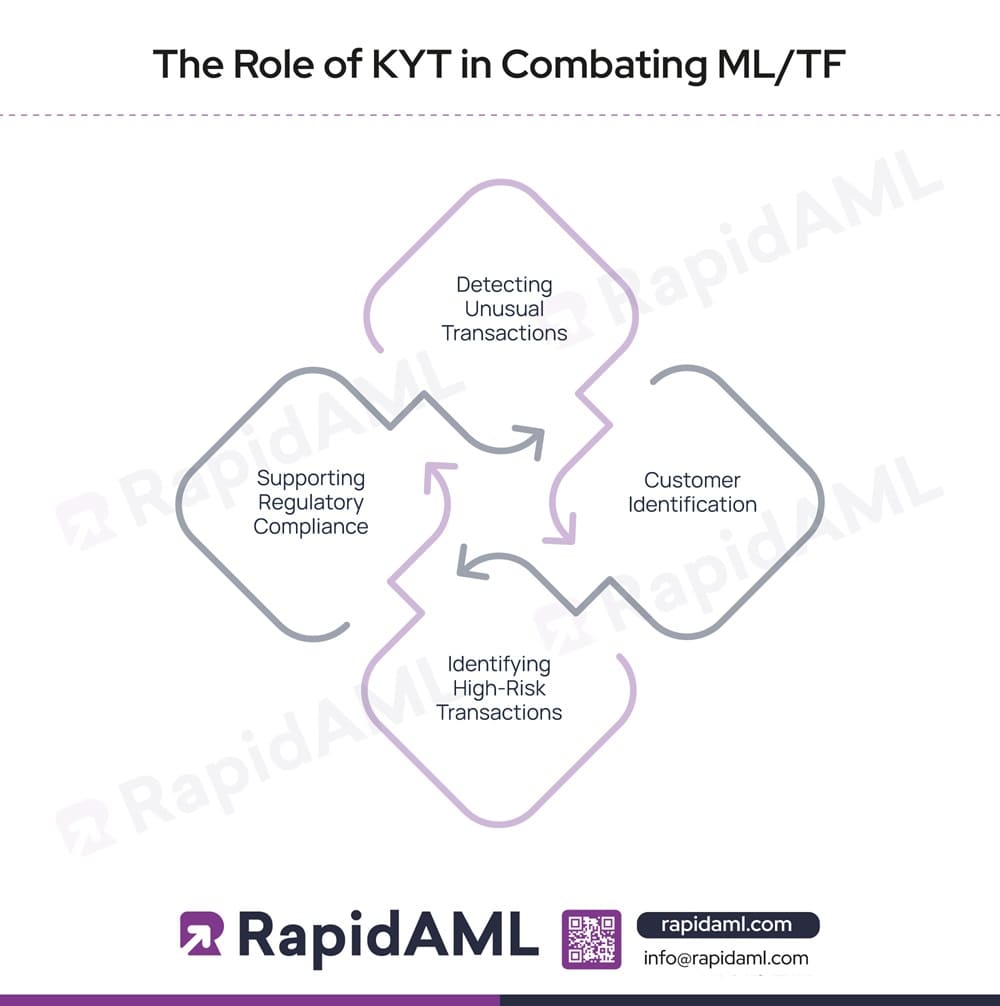
When KYC Still Matters for Compliance
The rise of the KYT graph does not render Know Your Customer (KYC) protocols obsolete; rather, it redefines their role within a modern compliance architecture. KYC remains the foundational layer for identity attribution, establishing the legal and regulatory baseline for who is participating in the financial system. Without this initial verification, transaction monitoring lacks the necessary context to distinguish between legitimate activity and illicit behavior.
Regulatory bodies, including the Financial Action Task Force (FATF) and FinCEN, maintain that identity verification is a non-negotiable requirement for anti-money laundering (AML) frameworks. The FATF’s recommendations emphasize that financial institutions must identify and verify the identity of their customers before establishing a business relationship. This requirement ensures that the entities behind the transactions are known, creating a permanent record of accountability that real-time monitoring alone cannot provide.
While the KYT graph excels at tracing the flow of funds and identifying suspicious patterns, it relies on the KYC data to attribute those patterns to specific individuals or entities. Think of KYC as the identity card and KYT as the security camera system. The camera can detect unusual movement, but without the ID card, it cannot determine who is responsible. Therefore, full compliance requires both: KYC for static identity verification and KYT for dynamic transactional context.
This dual approach satisfies the "Know Your Customer" and "Know Your Business" mandates simultaneously. By integrating KYT graph capabilities with robust KYC processes, institutions can achieve a more resilient compliance posture. The KYC layer provides the who, while the KYT layer provides the how and why, ensuring that regulatory obligations are met with both precision and depth.
Selecting a KYT Graph Provider
Selecting a KYT graph provider requires aligning technical capabilities with regulatory obligations. Under FATF Recommendation 16, virtual asset service providers must verify originator and beneficiary information for virtual asset transfers. A robust KYT graph solution must therefore offer real-time transaction monitoring APIs that integrate seamlessly with exchange infrastructure. Batch-processing tools are insufficient for high-volume environments where latency directly impacts compliance risk.
Coverage of major blockchains is non-negotiable. The provider must support Ethereum, Bitcoin, and other high-volume chains to ensure comprehensive visibility. Additionally, sanctions screening accuracy is critical. The system must align with OFAC and FinCEN lists to prevent facilitating illicit finance. Providers should demonstrate low false-positive rates through rigorous testing against known illicit addresses, ensuring that compliance teams can act on genuine threats without operational friction.
Frequently asked questions about KYT graph analytics
How does KYT graph analytics differ from traditional KYC?
KYC (Know Your Customer) is a static verification process that confirms identity at onboarding. KYT (Know Your Transaction) provides continuous, real-time monitoring of financial flows. While KYC establishes who the customer is, KYT graph analytics maps the network of transactions to detect suspicious patterns, such as layering or structuring, that static checks miss. This distinction is critical for meeting ongoing due diligence requirements outlined by the Financial Action Task Force (FATF).
Is KYT graph analytics replacing KYC?
No. KYT graph analytics does not replace KYC; it complements it. Regulatory bodies like FinCEN and OFAC require both initial identity verification and ongoing transaction monitoring. KYC serves as the foundational layer of customer due diligence (CDD), while KYT acts as the dynamic surveillance system. Using KYT graph analytics without KYC leaves institutions vulnerable to identity fraud, while relying solely on KYC fails to detect complex money laundering networks.
How does KYT graph analytics detect sanctions violations?
KYT graph analytics detects sanctions violations by analyzing transaction networks rather than just individual addresses. It identifies indirect links to sanctioned entities through multiple hops, uncovering shell companies or mixing services used to obscure fund origins. This capability aligns with OFAC’s guidance on avoiding transactions with blocked persons, ensuring that institutions can flag high-risk relationships that traditional screening tools might overlook.
No comments yet. Be the first to share your thoughts!