
Why graph analytics matter for DeFi compliance
Decentralized finance operates on a principle of pseudonymity that traditional compliance frameworks were not designed to handle. Simply tagging known malicious wallets is no longer sufficient. As transaction volumes scale and new protocols emerge, the ability to trace the flow of funds through complex, multi-hop interactions becomes the primary defense against financial crime. This is where graph analytics shifts from a nice-to-have feature to a regulatory necessity.
Traditional Know Your Transaction (KYT) systems often rely on static rules and pre-defined blacklists. These methods fail to capture the nuance of decentralized trading, where assets are routed through liquidity pools, mixers, and cross-chain bridges. A static list cannot account for the dynamic relationships between entities. Graph analytics, by contrast, maps the entire network of interactions. It identifies clusters of activity, detects circular trading patterns, and flags indirect exposure to sanctioned entities.
The core value lies in relationship mapping. Instead of asking "Is this address bad?", graph analytics asks "Who is this address connected to, and how?" This distinction allows compliance teams to assess risk based on behavior and network position rather than just historical labels. For example, an address may not be on a blacklist, but if it consistently interacts with high-risk mixing services, the graph reveals that association immediately.
This approach aligns with evolving regulatory expectations. Agencies like the Financial Action Task Force (FATF) emphasize the need for virtual asset service providers to monitor transactions for suspicious activity. Graph analytics provides the technical infrastructure to meet these standards by offering a comprehensive view of transaction flows. It transforms opaque blockchain data into actionable intelligence, enabling real-time decision-making that protects both the institution and the broader financial ecosystem.
How KYT graphs map transaction relationships
Know Your Transaction (KYT) systems rely on graph analytics to transform raw blockchain data into actionable compliance intelligence. Rather than viewing transactions as isolated events, these systems model the blockchain as a network of nodes and edges. Each node represents a wallet address, exchange, or smart contract, while each edge signifies a transfer of value. This structural mapping allows compliance officers to see the entire lifecycle of assets, revealing how funds move through the ecosystem in real time.
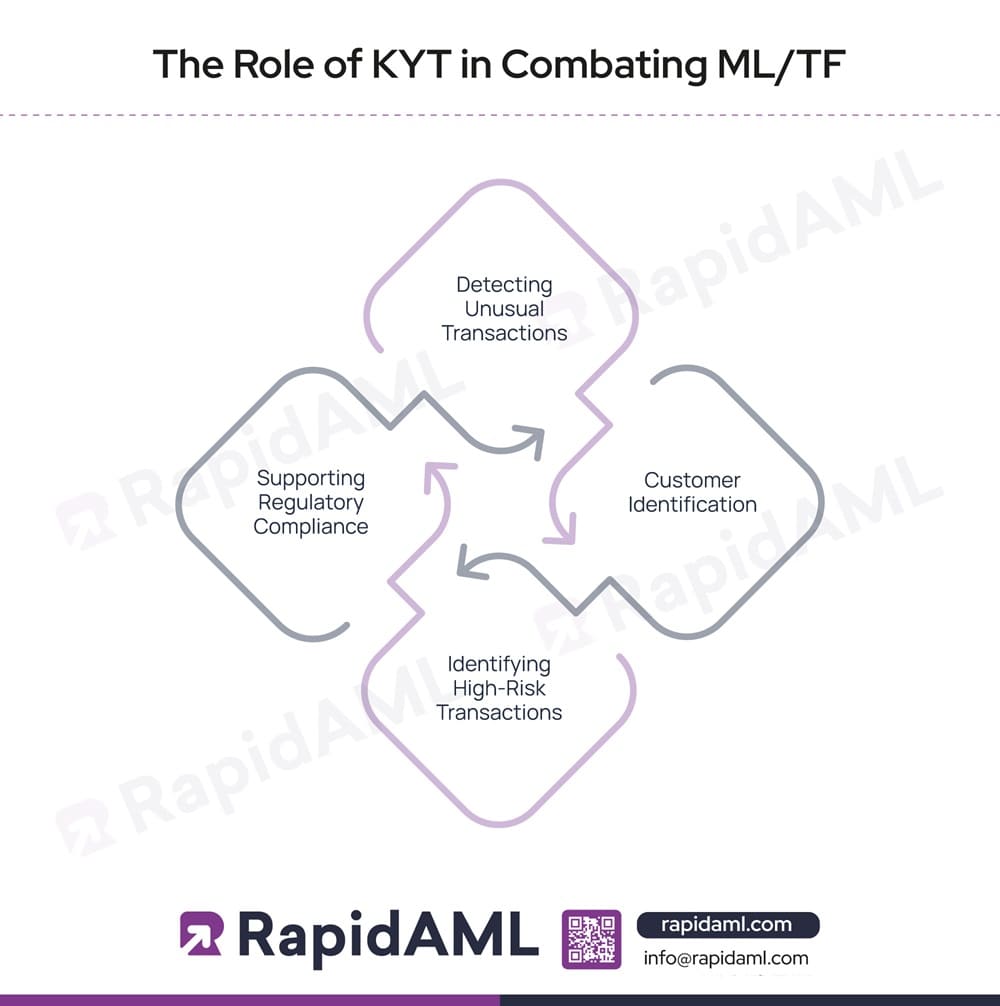
The primary function of this graph is to identify illicit patterns by tracing the path of funds from their origin to their current destination. By analyzing the connections between addresses, KYT tools can flag interactions with high-risk entities, such as mixers, darknet markets, or sanctioned addresses. This capability is essential for meeting Anti-Money Laundering (AML) regulations, which require financial institutions to understand the source and destination of customer funds. The graph reveals not just where money has been, but who it has touched, providing a clear audit trail that static transaction logs cannot offer.
Visualizing these relationships helps compliance teams distinguish between legitimate activity and suspicious behavior. For example, a sudden influx of funds from multiple unconnected addresses into a single wallet may indicate layering, a common money laundering technique. Conversely, direct transfers between known, compliant entities are typically low-risk. By contextualizing each transaction within the broader network, KYT graphs enable institutions to set precise risk thresholds and automate alerts for suspicious activity. This precision reduces false positives and allows compliance teams to focus their resources on genuine threats.
The effectiveness of KYT graph analytics lies in its ability to handle complexity. As DeFi protocols evolve, transaction patterns become increasingly sophisticated, often involving multiple hops and cross-chain bridges. Graph analytics can trace these complex paths, linking disparate transactions back to their root sources. This comprehensive view is critical for maintaining regulatory compliance in a rapidly changing digital asset landscape. Without this level of detail, institutions risk overlooking subtle but significant violations of AML and counter-terrorism financing (CTF) laws.
Real-time monitoring for AML risk detection
Real-time monitoring transforms anti-money laundering (AML) compliance from a retrospective audit into an active defense mechanism. By integrating graph analytics directly into the transaction lifecycle, compliance teams can evaluate risk scores before a block is finalized. This shift is critical in decentralized finance (DeFi), where the speed of settlement often outpaces traditional manual review processes.
The core operational benefit is the ability to flag or freeze transactions based on immediate risk indicators. Instead of waiting for end-of-day batch processing, systems analyze the graph of addresses involved in a transfer. If a transaction connects to a sanctioned entity or exhibits patterns consistent with layering, the system can trigger an automatic hold or require additional verification. This prevents illicit funds from moving further down the chain, preserving the integrity of the protocol and reducing regulatory exposure.
Accuracy is enhanced because graph analytics considers the broader context of a transaction. A single address might appear clean, but its connections to high-risk clusters reveal hidden dangers. Real-time monitoring ensures that these contextual risks are assessed instantly, allowing compliance officers to make informed decisions without slowing down legitimate user activity.
Top blockchain analytics tools for 2026
Selecting the right KYT graph solution requires matching specific compliance capabilities to your operational risk profile. While many platforms offer similar surface-level features, their effectiveness in real-time DeFi monitoring depends on proprietary graph algorithms, chain coverage, and integration depth. The following comparison outlines the primary differentiators among leading providers to help legal and compliance teams make informed procurement decisions.
| Provider | Supported Chains | Pricing Model | Integration Type |
|---|---|---|---|
| Chainalysis | 20+ | Custom Enterprise | API & SDK |
| Elliptic | 30+ | Subscription-based | REST API |
| TRM Labs | 25+ | Usage-based | GraphQL API |
| Dune Analytics | Multi-chain | Freemium | Community Dashboard |
Each provider approaches graph analytics differently. Chainalysis and Elliptic dominate the enterprise sector with mature, regulated frameworks suitable for traditional financial institutions requiring strict audit trails. TRM Labs focuses heavily on real-time transaction monitoring with a strong emphasis on DeFi protocol interaction mapping. Dune Analytics offers a more open-source, community-driven approach, ideal for projects that require custom query building rather than pre-packaged compliance reports.


As an Amazon Associate, we may earn from qualifying purchases.
When evaluating these tools, prioritize those that provide transparent documentation on their source of truth for address clustering and entity labeling. Compliance efficacy relies on the accuracy of the underlying graph data, not just the speed of detection. Ensure the selected platform supports the specific regulatory reporting formats required by your jurisdiction, such as FinCEN SARs or EU MiCA documentation standards.
Implementing KYT Graph Analytics in Your Workflow
Integrating Know Your Transaction (KYT) graph analytics requires shifting from reactive monitoring to proactive compliance architecture. For legal and regulatory teams, the goal is not merely to flag suspicious activity but to establish a defensible audit trail that aligns with FinCEN guidance and FATF standards. This section outlines the technical and operational steps to embed graph-based risk assessment into existing DeFi platforms or Web3 applications.

Begin by choosing a KYT provider that offers a robust API capable of real-time transaction graph traversal. The integration point should be your deposit or withdrawal gateway. Ensure the API returns structured data, including entity clustering and risk scores, rather than simple binary flags. This allows your compliance engine to make nuanced decisions based on the depth of the transaction graph, such as identifying layering patterns across multiple hops.
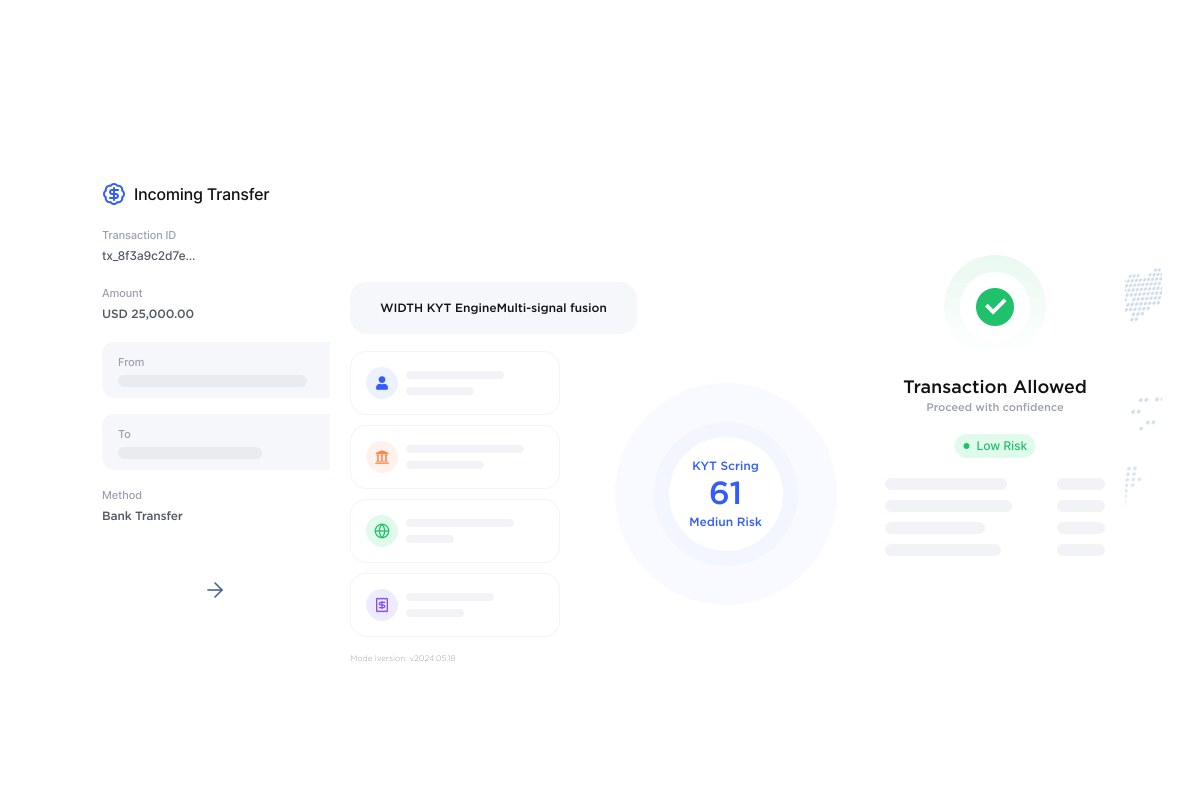
Generic risk scores are often insufficient for specific regulatory jurisdictions. Develop custom rules that trigger alerts based on the graph topology. For example, configure alerts for transactions involving high-risk clusters identified by regulatory bodies, or for addresses that exhibit rapid movement of funds through multiple intermediaries (mixers or privacy protocols). These rules should be documented in your compliance policy manual to demonstrate due diligence during regulatory examinations.
Deploy the KYT API as a synchronous check before finalizing on-chain transactions. If a transaction exceeds your defined risk threshold, the system should automatically pause the process for manual review. This "human-in-the-loop" approach ensures that false positives do not disrupt legitimate user activity while maintaining a strict barrier against illicit flows. Log all decision points, including the specific graph attributes that triggered the alert, to create a transparent audit trail.
Before full deployment, test your integration against known illicit addresses and sanctioned entities. Use historical transaction data to verify that your graph analytics correctly identify complex money laundering schemes, such as smurfing or structuring. Validate that your risk scoring aligns with industry standards and that your API latency remains within acceptable limits to avoid degrading user experience.
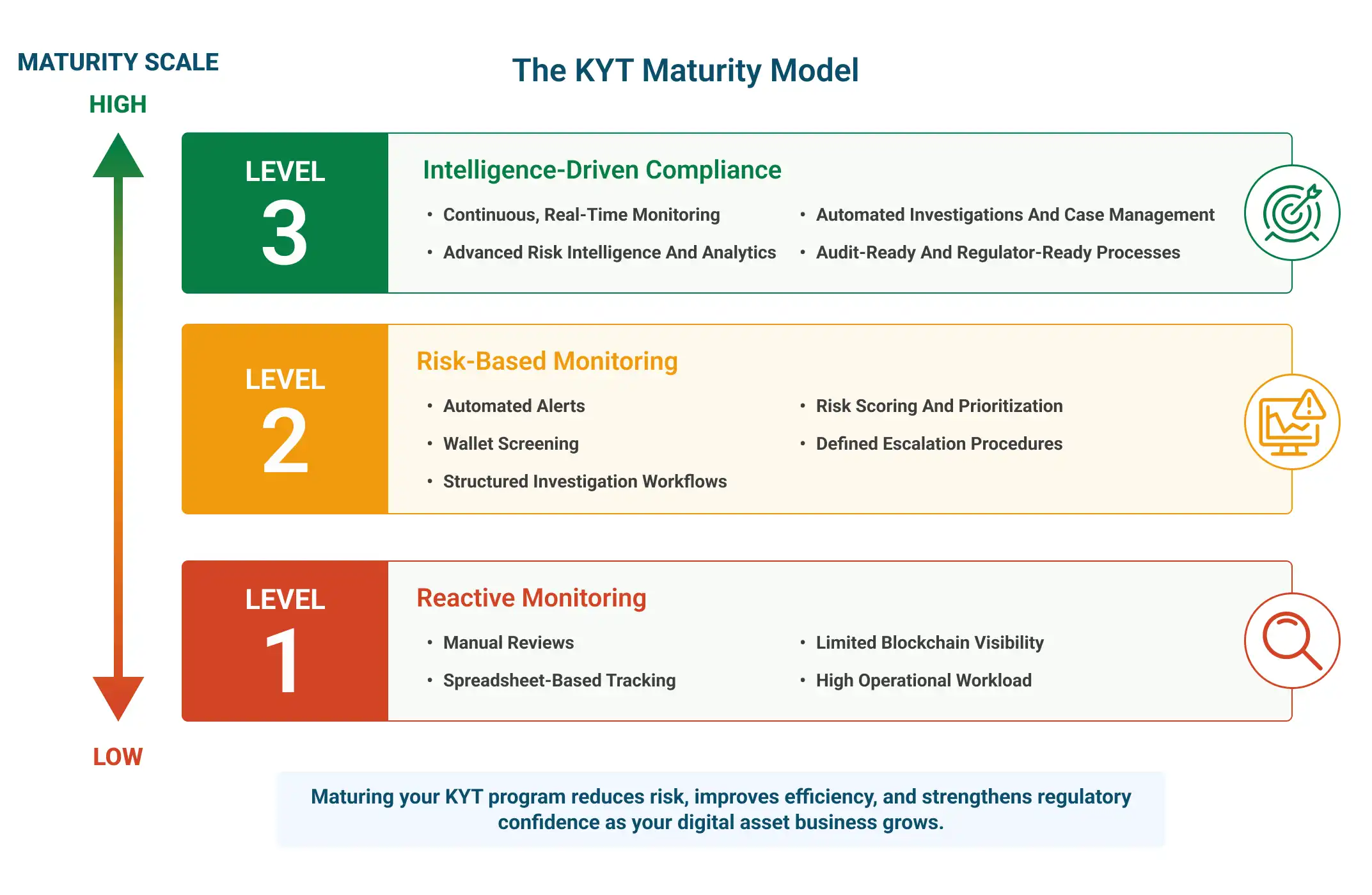
Regulatory threats evolve rapidly. Implement a feedback loop where compliance officers can update risk rules based on new typologies or regulatory changes. Regularly review false positive rates and adjust thresholds to maintain operational efficiency. Continuous monitoring ensures that your KYT graph analytics remain effective against emerging threats like cross-chain bridging risks or new DeFi exploit vectors.
By following these steps, your organization can build a resilient compliance framework that leverages the power of graph analytics to mitigate financial crime risks effectively.
No comments yet. Be the first to share your thoughts!