
The KYT Graph 2026 landscape
The regulatory environment for digital assets has shifted from reactive reporting to proactive prevention. In 2026, the standard for sanctions compliance is no longer just about flagging a transaction after it occurs; it is about understanding the context of the entire network. This shift is driven by the KYT Graph 2026 framework, which leverages graph technology to map complex relationships between addresses, entities, and jurisdictions in real time.
Traditional compliance tools often treat blockchain addresses as isolated data points. This siloed approach fails to capture the nuanced ways bad actors layer funds across multiple wallets and decentralized exchanges. Graph technology changes this by visualizing the connections between these entities. It allows compliance officers to see the full scope of a transaction’s origin and destination, identifying high-risk clusters that would otherwise remain hidden in the noise of the blockchain.
This proactive stance is critical for high-stakes regulatory environments. As enforcement actions become more frequent and penalties more severe, the ability to demonstrate due diligence is paramount. The framework provides the evidence needed to prove that an institution is not just checking boxes, but actively monitoring and mitigating risk. It transforms compliance from a cost center into a strategic advantage, ensuring that institutions can operate confidently in a rapidly evolving digital economy.
To understand the scale of the problem that graph technology addresses, consider the volatility and volume of sanctioned addresses. The following chart illustrates the market dynamics that drive the need for real-time monitoring.
How real-time monitoring works
Real-time monitoring replaces the traditional batch-processing model with continuous, transaction-level analysis. In a batch system, data is collected over a set interval—often hours or days—and then reviewed. This lag creates a window where illicit funds can move across multiple wallets or chains before detection. Real-time monitoring closes that gap by evaluating every transaction as it occurs on the blockchain.
The system relies on graph database technology to map relationships between addresses instantly. When a transaction is broadcast, the monitoring engine traces the input and output addresses against sanctions lists, known bad actors, and high-risk patterns. This process happens in milliseconds, allowing compliance teams to flag or freeze assets before the transaction is confirmed.
Speed is the primary advantage, but accuracy is equally critical. Real-time systems reduce false positives by contextualizing transactions within the broader network graph. Instead of flagging an address solely because it touched a known illicit wallet once, the system analyzes the depth and nature of the connection. This distinction helps compliance teams focus on genuine risks rather than noise.
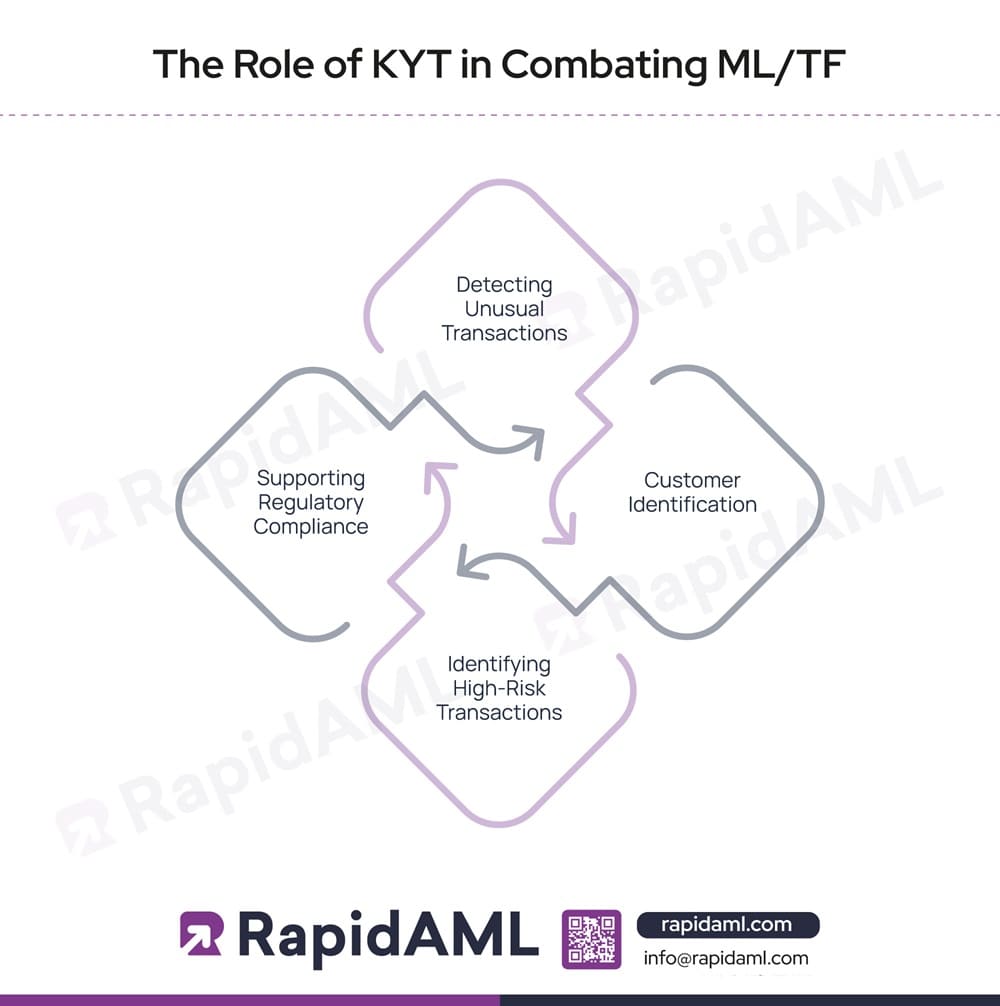
This approach ensures that sanctions compliance is not just a retrospective audit but a proactive defense mechanism. By integrating real-time monitoring into the transaction lifecycle, organizations can maintain regulatory adherence without sacrificing operational efficiency.
AI fraud detection patterns
Traditional rule-based systems struggle to identify sophisticated laundering techniques because they rely on static thresholds. AI models, by contrast, analyze transaction graphs in real-time to detect complex relationships that static rules miss. This shift is critical for sanctions compliance, where adversaries constantly evolve their methods to evade detection.
Detecting Mixer and Tumbler Activity
AI models identify interactions with privacy-enhancing services by analyzing the structure of transaction flows rather than just the destination addresses. When funds move through multiple layers of mixing services before reaching a sanctioned entity, machine learning algorithms can flag the probabilistic link. This capability allows compliance teams to block transactions that appear clean on the surface but are part of a larger obfuscation strategy.
Identifying Layering Networks
Layering involves splitting funds across numerous accounts to obscure their origin. AI detects these patterns by recognizing behavioral anomalies, such as rapid, round-trip transactions or unusual timing between transfers. By mapping the velocity and volume of these movements, the system flags networks that deviate from normal user behavior. This approach is far more effective than checking individual addresses against static blacklists.
The Cost of Missed Detections
Real-Time Graph Analysis
The integration of AI with graph technology enables the analysis of entire transaction networks in real-time. Instead of evaluating transactions in isolation, the system evaluates the context of each node within the graph. This holistic view reveals hidden connections between seemingly unrelated parties, providing a comprehensive picture of potential sanctions violations.
Regulatory compliance 2026 standards
The regulatory landscape for 2026 demands more than static record-keeping. Financial institutions and virtual asset service providers (VASPs) now face simultaneous pressure from the Financial Action Task Force (FATF) and regional mandates that require real-time visibility into transaction networks. Traditional compliance methods, which rely on batch processing and historical snapshots, are no longer sufficient to meet these evolving standards.
Regulators are shifting focus toward proactive monitoring. The FATF’s updated guidance emphasizes the need for institutions to understand the source and destination of funds in near real-time. This means identifying complex layering techniques and mixing services before transactions are finalized, rather than reporting them after the fact. Compliance is no longer a backward-looking audit; it is a forward-looking risk management function.
To illustrate the operational differences between legacy approaches and modern graph-based solutions, consider the following comparison of compliance requirements.
| Feature | Traditional KYC/KYT | Graph-Based KYT | 2026 Compliance Impact |
|---|---|---|---|
| Data Structure | Siloed, linear records | Connected network nodes | Graphs reveal hidden relationships |
| Detection Latency | Batch (hours to days) | Real-time (milliseconds) | Meets real-time monitoring mandates |
| Sanctions Screening | Exact match only | Fuzzy match & cluster analysis | Reduces false negatives |
| Risk Scoring | Static, rule-based | Dynamic, behavioral | Adapts to emerging typologies |
Traditional systems often rely on exact-match screening against static sanctions lists. While effective for known bad actors, this approach misses entities that use subtle variations or cluster around sanctioned addresses. Graph-based KYT analyzes the entire transaction path, identifying clusters of activity that exhibit suspicious patterns even if individual addresses are not yet flagged. This dynamic risk scoring allows institutions to prioritize high-risk transactions for immediate review.
Regional mandates, such as those from the EU’s MiCA framework and various US state-level regulations, are increasingly codifying these expectations. Institutions that continue to use legacy tools face higher regulatory scrutiny and potential penalties. Adopting graph technology is no longer just a competitive advantage; it is a regulatory necessity for robust compliance in 2026.
Blockchain analytics trends
The landscape of blockchain data infrastructure is shifting from isolated chain monitoring to interconnected, multi-service architectures. As outlined in The Graph's 2026 technical roadmap, the industry is moving toward a protocol called Horizon designed to serve developers across diverse ecosystems simultaneously [[src-serp-6]]. This transition allows compliance tools to ingest data from multiple blockchains without relying on fragmented, single-chain indexes.
Cross-chain monitoring is no longer optional for sanctions compliance. Criminal networks increasingly utilize bridge protocols and cross-chain swaps to obscure fund trails. Analytics providers must now track asset movement across at least five major chains to maintain an accurate risk profile. A transaction that appears clean on Ethereum may be part of a laundering scheme originating on a privacy-focused or lower-liquidity chain.
Privacy coin analysis remains a critical frontier. While some exchanges delist privacy assets, they continue to circulate in decentralized finance (DeFi) and peer-to-peer markets. Effective monitoring requires deep packet inspection of transaction graphs to identify patterns of obfuscation, such as coinjoin services or mixing protocols. Regulatory bodies are increasingly demanding that institutions report not just the origin of funds, but the complexity of their path through these opaque networks.
No comments yet. Be the first to share your thoughts!