
Kyt graph choices that change the plan
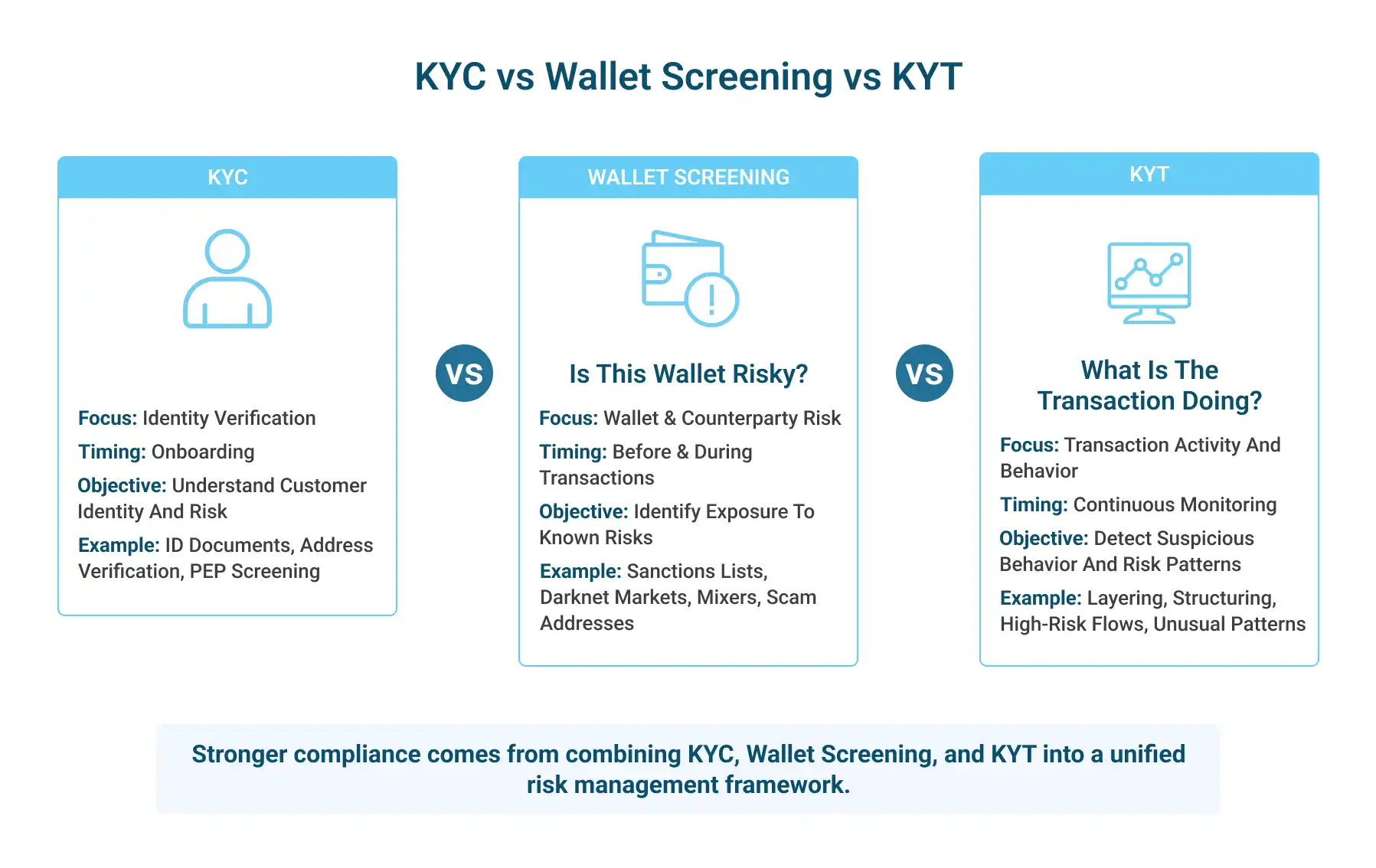
Choosing between KYC and KYT requires understanding where compliance friction meets operational speed. KYC (Know Your Customer) provides a static identity baseline, while KYT (Know Your Transaction) monitors real-time behavior. The decision hinges on whether you prioritize verified identity or live risk signals.
KYC is essential for initial onboarding and regulatory reporting. It answers who the user is. KYT answers what the user is doing. For high-volume crypto exchanges, relying solely on KYC leaves a blind spot between sign-up and the first transaction. KYT fills that gap by screening wallet activity against sanction lists and mixing services in real time.
| Feature | KYC (Identity) | KYT (Transaction) |
|---|---|---|
| Primary Focus | User identity verification | Real-time transaction monitoring |
| Data Type | Static (ID, address, selfie) | Dynamic (wallet history, flow) |
| Update Frequency | Periodic re-verification | Continuous / Real-time |
| Risk Detection | Front-loaded (onboarding) | Ongoing (post-onboarding) |
| Compliance Goal | AML/CTF Identity Checks | Sanctions & Money Laundering |
The tradeoff is clear: KYC reduces fraud at entry, but KYT prevents illicit flows after entry. A robust compliance stack uses both. KYC establishes the entity; KYT watches its actions. Without KYT, you are reacting to history rather than preventing active risk.
| Feature | KYC | KYT |
|---|---|---|
| Primary Focus | User identity verification | Real-time transaction monitoring |
| Data Type | Static (ID, address, selfie) | Dynamic (wallet history, flow) |
| Update Frequency | Periodic re-verification | Continuous / Real-time |
| Risk Detection | Front-loaded (onboarding) | Ongoing (post-onboarding) |
| Compliance Goal | AML/CTF Identity Checks | Sanctions & Money Laundering |
For most regulated entities, the choice is not either/or. It is a layered defense. Start with KYC to clear the gate. Use KYT to monitor the flow. This combination satisfies regulators who expect both identity assurance and transaction transparency.
Where each option wins
Knowing when to use KYC versus KYT prevents compliance bottlenecks while ensuring regulatory safety. The decision usually comes down to whether you need to verify a specific person or monitor the flow of assets.
KYC: Best for Identity Verification
Know Your Customer (KYC) is the standard for establishing a user's identity. It is mandatory for onboarding and high-risk activities where regulations require proof of who is behind an account. Use KYC when:
- You are onboarding new users to a regulated platform.
- You must verify government-issued identification documents.
- Your jurisdiction requires strict identity checks for large transactions.
KYT: Best for Real-Time Monitoring
Know Your Transaction (KYT) focuses on the reliability of the wallet or address involved. It screens the origin and destination of funds against risk databases. Use KYT when:
- You need to detect money laundering patterns in real time.
- You are processing crypto payments without knowing the user's identity.
- You need to flag interactions with sanctioned addresses or mixers.
The Hybrid Approach
Most modern compliance programs use both. KYC provides the identity layer, while KYT provides the transactional safety net. Relying on only one leaves gaps in your risk management strategy.
| Feature | KYC | KYT |
|---|---|---|
| Primary Goal | Verify Identity | Screen Transactions |
| Data Type | Personal Info | Wallet Addresses |
| Timing | Onboarding | Real-Time |
| Regulatory Focus | AML/CFT | AML/CFT |
Details worth checking
Before deploying real-time transaction monitoring, verify the specific risks and exclusions embedded in your provider’s workflow. A gap in coverage can leave an organization exposed to regulatory penalties even if the KYC data is pristine.
Not all providers screen every blockchain or jurisdiction equally. Confirm whether your tool covers emerging networks, privacy-focused coins, or high-risk geographic regions. Missing these assets creates blind spots where illicit funds can hide.
Real-time monitoring requires sub-second data updates. If your provider relies on daily batch updates, your transaction risk scores will be outdated by the time they are applied. Ensure the API latency matches your compliance SLA requirements.
High false positive rates can overwhelm your compliance team. Verify that the platform allows you to customize risk thresholds and whitelist trusted addresses. Without this flexibility, you will spend more time investigating clean transactions than actual threats.
Ensure the system can automatically generate Suspicious Activity Reports (SARs) or equivalent filings. Manual reporting is error-prone and slow. The best platforms integrate directly with regulatory portals or export data in standard formats required by your local financial authority.
KYT Graph: Common Questions Answered
When navigating the intersection of blockchain compliance and physical safety standards, "KYT" becomes a source of confusion. In our industry, it stands for Know Your Transaction, a real-time monitoring protocol for digital assets. However, many riders encounter the same acronym applied to KYT helmets, a popular brand in sport touring. Below, we separate the compliance definition from the equipment queries to prevent costly misunderstandings.
What does KYT mean in compliance?
Know Your Transaction (KYT) refers to the process of verifying the reliability of a wallet by screening its activity, including the origin and destination of transactions. This is crucial for ensuring compliance with anti-money laundering (AML) and counter-terrorist financing (CTF) regulations. Unlike static KYC checks, KYT provides continuous monitoring of on-chain behavior, flagging suspicious patterns as they happen rather than after the fact.
Is the KYT R2R good for touring?
The KYT R2R is designed as an all-around helmet ready for long rides that start in the morning and continue into the evening. It features a drop-down internal sun visor and superior ventilation, making it suitable for varied conditions. While not a heavy-duty adventure tourer, its aerodynamic profile and comfort make it a strong choice for sport touring enthusiasts who prioritize speed and visibility over rugged off-road capability.
How do you know if your KYT is original?
Original KYT helmets come with high-quality, durable labels that are clearly printed. Look for the precise KYT logo, specific model names, and certification details like ECE or DOT marks. Counterfeit versions often have blurry text, peeling stickers, or missing safety certifications. Always purchase from authorized dealers to ensure the helmet meets the rigorous safety standards required for high-speed riding.
Is the KYT R2R aerodynamic?
Yes, the R2R is built with outstanding aerodynamics to reduce wind noise and drag. The helmet’s shape is optimized for stability at high speeds, offering a huge field of vision while maintaining a sleek profile. This design ensures that airflow is managed efficiently, providing comfort and safety during extended periods on the open road.
No comments yet. Be the first to share your thoughts!