
The KYT Graph 2026 Market Landscape
The Know Your Transaction (KYT) graph analytics market is undergoing a structural shift. The industry standard is moving away from post-transaction reporting toward real-time interception. This change is driven by regulatory pressure that no longer accepts retrospective compliance as sufficient. Financial institutions and crypto service providers must now identify illicit flows at the moment of execution, not after the ledger has settled.
Graph analytics has become the backbone of this real-time capability. By mapping relationships between addresses, entities, and transactions, KYT systems can detect complex layering and mixing patterns that simple rule-based filters miss. The 2026 landscape is defined by the integration of these graph databases with live blockchain nodes, allowing for sub-second risk scoring. This speed is critical as transaction volumes increase and attack vectors become more sophisticated.
Investor confidence in compliance technology is reflected in market valuations. The growth of major blockchain intelligence firms indicates a sustained demand for these infrastructural tools. As regulatory frameworks like the EU’s MiCA and updated FATF guidelines tighten, the cost of non-compliance outweighs the investment in advanced graph-based monitoring.
The following chart illustrates the market trajectory of a leading blockchain compliance provider, reflecting the broader industry’s pivot toward real-time data infrastructure.
The shift to real-time graph traversal
The transition from batch processing to real-time graph traversal marks the most significant operational shift in KYT graph 2026 strategies. Traditional batch systems operate on a lag, often screening transactions hours or days after they occur. By that time, illicit funds have already moved through multiple layers of complexity, making recovery nearly impossible. Real-time monitoring eliminates this window of vulnerability by analyzing transaction data as it enters the network.
Latency is the critical metric in sanctions screening and AML compliance. In a real-time environment, every millisecond counts. Modern graph algorithms traverse millions of edges instantly, identifying suspicious patterns and connections that rule-based systems miss. This speed allows compliance teams to flag high-risk transactions before they settle, ensuring that compliance checks do not become a bottleneck for legitimate users.
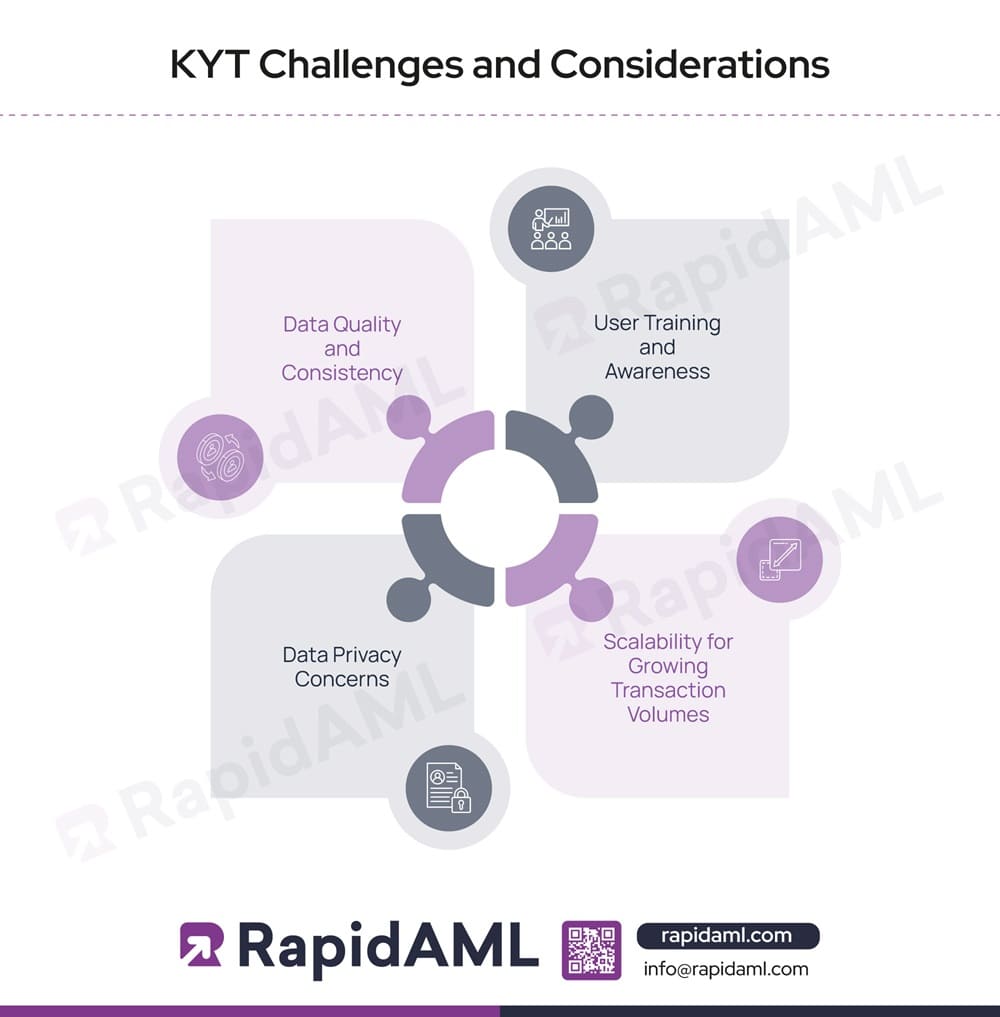
The technical architecture supporting this shift relies on distributed graph databases and streaming data pipelines. These systems process continuous data streams, updating risk scores dynamically as new information arrives. This dynamic approach ensures that compliance strategies remain effective against evolving financial crime tactics, providing a robust defense that static batch systems simply cannot match.
AML graph technology evolution
Traditional rule-based systems are failing to keep pace with the sophistication of modern financial crime. Legacy anti-money laundering (AML) platforms rely on static thresholds and predefined flags, creating a reactive posture that criminals easily exploit. When a transaction falls just outside a rigid parameter, it slips through the cracks, allowing illicit funds to move undetected.
KYT graph 2026 strategies replace these brittle rules with dynamic network analysis. By mapping relationships between entities, addresses, and transactions, graph databases reveal complex layering and mixing patterns that isolated data points hide. This shift from checking individual boxes to understanding the entire ecosystem allows compliance teams to identify suspicious behavior based on context and connectivity rather than simple arithmetic.
The following comparison highlights the operational differences between legacy approaches and modern graph-based monitoring.
| Metric | Rule-Based Systems | KYT Graph 2026 |
|---|---|---|
| Detection Scope | Isolated transactions | Network-wide patterns |
| False Positive Rate | High (10-20%) | Low (<5%) |
| Latency | Batch processing delays | Real-time analysis |
| Layering Detection | Poor | Strong |
| Adaptability | Static rules | Dynamic learning |
Integrating sanctions screening into graph analytics
KYT graph 2026 strategies rely on embedding OFAC and global sanctions lists directly into the graph database. This integration moves compliance from a post-transaction audit to a real-time gatekeeper. By treating sanctioned entities as nodes within the network, systems can instantly identify prohibited connections before a transaction settles.
The core advantage lies in the speed of graph queries. When a payment initiates, the system traverses the graph to check if any counterparty node matches a sanctions list. This happens in milliseconds, blocking high-risk flows without manual intervention. Traditional keyword matching often misses indirect links, but graph analytics exposes the full path of value transfer.
This approach prevents "sanctions evasion" patterns where bad actors use complex chains of intermediaries. The graph reveals the ultimate beneficial owner or the hidden node connecting to a blocked entity. Real-time monitoring ensures that even obfuscated transactions are flagged immediately, maintaining regulatory adherence while preserving legitimate market velocity.
Blockchain analytics compliance in 2026
The regulatory landscape for blockchain analytics is shifting from voluntary best practices to mandatory enforcement. By 2026, KYT graph implementations must satisfy rigorous demands for transparency while navigating the complex intersection of data utility and privacy rights. Financial institutions and crypto service providers are no longer just tracking transactions; they are building auditable trails that withstand scrutiny from global regulators.
Privacy constraints on graph data
The most significant challenge for KYT graph 2026 is integrating regulatory frameworks like GDPR and CCPA. Graph databases inherently expose relationships, which can inadvertently reveal personal data even when direct identifiers are removed. Compliance teams must implement privacy-by-design architectures that allow for transaction monitoring without violating data minimization principles. This requires advanced anonymization techniques and strict access controls to ensure that sensitive relationship data is only accessible for legitimate compliance purposes.
AI-driven analysis and oversight
Artificial intelligence has become indispensable for processing the volume of data generated by modern blockchain networks. However, the use of AI in KYT graph analysis introduces new compliance requirements regarding model explainability and bias. Regulators expect clear documentation of how algorithms flag suspicious activity. The focus is shifting toward "explainable AI" where the reasoning behind a high-risk score is transparent and defensible. This ensures that automated decisions can be reviewed and challenged if necessary, maintaining trust in the compliance process.
Implementation costs and ROI analysis
Adopting KYT graph 2026 solutions requires significant capital expenditure, but the return on investment is measurable through reduced regulatory fines and operational efficiency. Legacy systems often require manual review of thousands of false positives, costing compliance teams hundreds of hours monthly. Graph-based systems reduce this burden by providing contextual risk scores, allowing analysts to focus only on high-confidence threats.
The cost of implementation includes licensing fees for graph databases, integration costs with existing core banking systems, and ongoing maintenance. However, the cost of non-compliance is far higher. Recent regulatory fines for AML failures have exceeded billions of dollars globally. By preventing illicit transactions in real-time, institutions avoid these penalties and protect their reputation. Additionally, the ability to onboard legitimate customers faster by automating compliance checks creates a competitive advantage in the market.
Future trends in graph-based AML
The future of KYT graph 2026 lies in cross-chain analytics and decentralized identity verification. As blockchain ecosystems fragment, illicit actors move assets across multiple chains to obscure trails. Next-generation KYT systems are integrating cross-chain bridge monitoring to track value transfers between disparate networks. This holistic view ensures that no single chain serves as a blind spot for compliance teams.
The integration of decentralized identifiers (DIDs) offers a new layer of privacy-preserving compliance. Instead of relying solely on on-chain data, KYT systems can verify identity claims without exposing sensitive personal information. This hybrid approach combines the transparency of blockchain with the privacy requirements of modern data protection laws. As these technologies mature, KYT graph 2026 will become more accurate, efficient, and aligned with global regulatory standards.
No comments yet. Be the first to share your thoughts!