
KYC vs. KYT graph analytics defined
Know Your Customer (KYC) and Know Your Transaction (KYT) serve distinct functions in financial compliance, yet they are often conflated. KYC is a static identity verification process performed at onboarding. It confirms that a user is who they claim to be by validating government-issued documents and biometric data. This process establishes the initial legal relationship between the institution and the customer.
KYT graph analytics, by contrast, is a dynamic monitoring system that tracks the flow of funds in real-time. While KYC answers "who," KYT answers "where" and "how" money moves. Graph analytics visualizes the complex web of transactions between entities, revealing hidden connections that traditional rule-based monitoring misses. This capability is essential for detecting sophisticated money laundering schemes that rely on layering funds through multiple accounts to obscure their origin.
The critical gap lies in the fact that a verified identity does not guarantee clean funds. Illicit actors often use "mule accounts"—accounts controlled by unwitting or coerced individuals—to move stolen money. Graph analytics detects these anomalies by identifying patterns such as rapid fund movement, circular transactions, or links to sanctioned entities. Without this real-time visibility, institutions remain blind to the actual risk posed by their customers' transactional behavior.
Regulatory bodies like the Financial Action Task Force (FATF) and FinCEN emphasize the need for ongoing monitoring rather than one-time verification. The KYT graph provides the operational infrastructure to meet these requirements, transforming compliance from a reactive checklist into a proactive defense against financial crime.
How KYT Graph Analytics Detects Risk
Graph analytics transforms blockchain data from a flat ledger into a connected network. In this structure, blockchain addresses are nodes, and transactions are the edges linking them. This topology allows compliance systems to identify relationships that simple address screening misses. Instead of checking a wallet in isolation, KYT evaluates its position within the broader web of fund flows.
The system relies on clustering algorithms to group addresses that share control or operational patterns. These clusters often reveal the underlying structure of exchanges, mixers, or darknet markets. By treating a cluster as a single entity, analysts can assess the risk of an entire operation rather than individual wallets. This approach is essential for identifying complex layering techniques used in money laundering.
Path analysis traces the movement of funds from a source to a destination. If a transaction connects to a known sanctioned address, the system flags the entire path. This real-time monitoring ensures that even indirect exposure to illicit funds is captured. The FATF emphasizes the importance of such transaction monitoring to prevent the financing of terrorism and proliferation.
Real-time flagging is the final layer of detection. When a high-risk node is identified, the system instantly alerts compliance teams. This speed allows institutions to freeze assets or file Suspicious Activity Reports (SARs) before funds are moved further. The ability to act immediately reduces the window for illicit actors to obscure their trails.
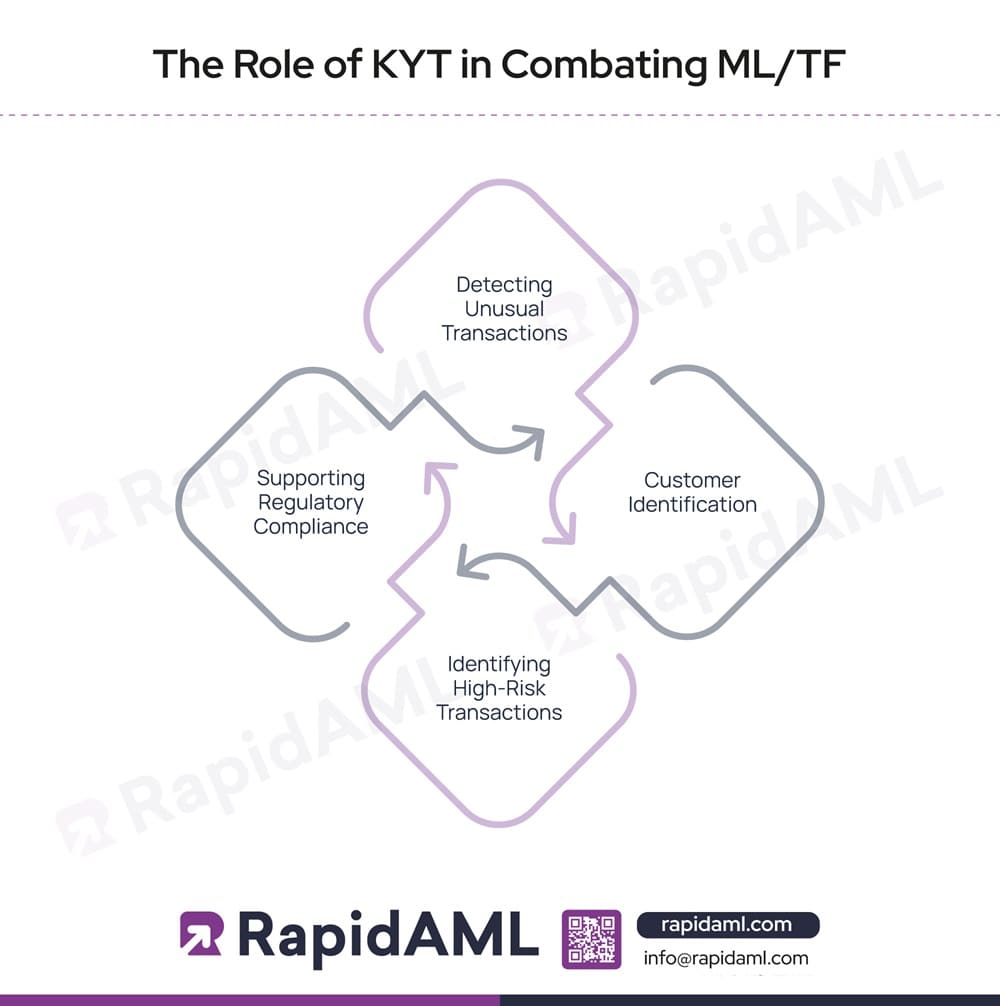
KYC and KYT graph comparison table
Compliance programs rely on two distinct but complementary layers of defense: Know Your Customer (KYC) and Know Your Transaction (KYT). While KYC establishes the identity and risk profile of an entity, KYT monitors the flow of assets in real time. Understanding the technical and operational differences between these frameworks is essential for allocating resources effectively.
KYC is primarily a static, entry-point verification process. It involves collecting identity documents, screening against sanctions lists, and assessing beneficial ownership. This process is mandated by regulators such as FinCEN and the FATF to prevent onboarding bad actors. However, KYC does not monitor behavior after onboarding. A customer who passes KYC can still engage in illicit activity, such as structuring deposits or using mixed funds for money laundering.
KYT addresses this gap by analyzing transactional data using graph analytics. Instead of checking a static profile, KYT traces the movement of funds through complex networks. It identifies patterns indicative of illicit finance, such as layering in money laundering or rapid movement of funds through high-risk jurisdictions. For example, graph analytics can detect when a wallet interacts with a sanctioned entity, even if the funds pass through multiple intermediate addresses. This real-time monitoring allows institutions to flag suspicious activity before it is completed.
The table below compares the core capabilities and regulatory roles of KYC and KYT.
| Dimension | KYC (Know Your Customer) | KYT (Know Your Transaction) |
|---|---|---|
| Primary Timing | Onboarding and periodic review | Real-time and post-transaction |
| Data Source | Identity documents, beneficial ownership registries | Blockchain explorers, transaction histories, wallet labels |
| Risk Detection | Static screening against sanctions lists (OFAC, UN) | Graph analytics for network patterns, clustering, and laundering |
| Regulatory Focus | FATF Recommendation 10 (Customer Due Diligence) | FATF Recommendation 16 (Wire Transfers) and ongoing monitoring |
| Limitation | Cannot detect behavior after onboarding | Requires high-quality data labeling to avoid false positives |
Real-time transaction monitoring use cases
Real-time transaction monitoring transforms graph analytics from a retrospective audit tool into an active defense system. By analyzing network topology as funds move, institutions can identify illicit patterns before they settle. This capability is essential for high-stakes compliance, particularly when tracking complex money laundering structures and ransomware payments.
Mixing service detection
Cryptocurrency mixers and tumblers are designed to obfuscate the origin of digital assets, making them attractive for money laundering. Graph analytics detects these services not by watching a single transaction, but by identifying the distinct "churn" patterns in the network. When a wallet exhibits high-frequency, fragmented inputs and outputs that do not align with standard commercial or personal behavior, the graph flags the topology as suspicious.
Regulatory bodies like FinCEN have issued guidance on the risks associated with decentralized mixers, noting their potential to violate the Bank Secrecy Act. Real-time monitoring systems can flag interactions with known mixing protocols or wallets that show signs of recent mixing activity, allowing compliance teams to file Suspicious Activity Reports (SARs) with greater precision. This approach moves beyond simple address blacklisting to behavioral analysis of the transaction flow.
Ransomware fund tracking
Ransomware payments often follow a predictable path: from victim to initial exchange, then to mixers, and finally to off-ramps where criminals cash out. Graph analytics maps these connections in real time, linking the initial ransom payment to subsequent laundering attempts. By visualizing the flow of funds across the blockchain, investigators can identify the "clean" wallets where criminals attempt to withdraw fiat currency.
The FATF has highlighted the growing threat of ransomware and the importance of tracking virtual asset service providers (VASPs) involved in these chains. Real-time monitoring enables institutions to freeze assets or block transactions at the off-ramp stage, disrupting the criminal enterprise. This proactive stance reduces the recoverability of illicit funds and increases the operational cost for threat actors.
Integrating KYT into your compliance stack
Integrating Know Your Transaction (KYT) graph analytics into an existing compliance stack requires moving beyond static rule sets. While Know Your Customer (KYC) establishes the identity of the actor, KYT monitors the behavior of their assets in real-time. This integration transforms compliance from a retrospective audit into a proactive defense against money laundering and sanctions evasion.
The goal is to embed graph analytics directly into the transaction lifecycle, allowing risk scoring to occur before funds settle. This approach aligns with FATF recommendations, which emphasize the need for continuous monitoring of complex transaction patterns that traditional systems miss.
Define risk scoring thresholds
Before connecting any APIs, establish clear risk thresholds. Graph analytics excel at detecting indirect exposure, such as a transaction passing through three hops before reaching a sanctioned entity. Set thresholds that trigger alerts for high-risk cluster interactions, not just direct hits on OFAC lists. This prevents alert fatigue while catching sophisticated layering schemes.
Select a provider API
Choose a KYT provider with a robust API that supports real-time graph traversal. The integration must allow your internal systems to query transaction histories and relationship maps instantly. Ensure the provider’s data sources are updated frequently to reflect the dynamic nature of crypto networks. A lagging data feed renders real-time monitoring ineffective.
Configure real-time alerts
Configure your system to send immediate notifications when a transaction exceeds defined risk scores. These alerts should include context from the graph, such as the specific nodes and edges that triggered the flag. This context allows compliance officers to investigate quickly and accurately, reducing the time between detection and action.
Test with historical data
Validate your integration using historical transaction data. Run past transactions through the new graph analytics engine to see how many alerts would have been generated. This backtesting helps refine thresholds and ensures the system catches known illicit patterns without overwhelming the team with false positives.
Frequently Asked Questions About KYT Graph Analytics
Is KYT required by law?
While the FATF Recommendations do not explicitly mandate "KYT" as a standalone term, they require financial institutions to conduct ongoing due diligence on business relationships and scrutinize complex transactions. The FATF emphasizes that institutions must monitor transactions to detect suspicious activity, particularly in virtual asset service providers (VASPs). Consequently, regulators in jurisdictions like the United States (FinCEN) and the European Union (AMLD5/6) expect robust monitoring systems. Real-time graph analytics are increasingly viewed as the operational standard to meet these regulatory obligations for detecting illicit flows.
How does KYT graph analytics differ from traditional AML?
Traditional AML systems often rely on rule-based screening of individual transactions, which can miss complex laundering schemes. Graph analytics maps the relationships between entities, revealing hidden networks. For example, if multiple unrelated wallets send funds to a single exchange address shortly before a large transfer to a sanctioned entity, a graph algorithm detects this "smurfing" pattern instantly. This structural analysis allows compliance teams to identify layering and integration stages of money laundering that threshold-based systems typically overlook.
What is the role of real-time monitoring in sanctions compliance?
Real-time monitoring acts as the primary defense against sanctions evasion. By analyzing transaction graphs at the moment of initiation, institutions can block transfers involving sanctioned addresses or their immediate neighbors before funds are moved. This is critical for preventing exposure to entities like those listed on the OFAC SDN list. Real-time graph analytics reduce the "time-to-detect" from days or weeks to milliseconds, ensuring that compliance teams can freeze assets and file Suspicious Activity Reports (SARs) with precise, traceable data.
Can KYT graph analytics reduce false positives?
Yes. Traditional systems often flag legitimate transactions because they lack context. Graph analytics provide this context by understanding the nature of the counterparty and the transaction history. If a wallet has a long history of interacting only with known, compliant entities, a single transaction to a new address is less likely to be flagged as high-risk compared to a wallet with no history. This reduces the operational burden on compliance teams, allowing them to focus on genuine threats rather than reviewing thousands of benign alerts.
No comments yet. Be the first to share your thoughts!