
In the wake of Russia's prolonged conflict with Ukraine, the European Union has escalated its sanctions regime to target cryptocurrency channels that Moscow exploits for evasion. The October 2025 ban on the Russian ruble-backed stablecoin A7A5, which handled over $70 billion in transactions since February 2025, exemplifies this shift. Effective November 25,2025, this measure blocks all A7A5 activity within EU borders, yet bad actors swiftly adapt with mixers, privacy coins, and layered wallet structures. Graph analytics emerges as the linchpin for compliance teams, mapping these opaque networks to expose crypto sanctions evasion before funds cross borders.

Financial institutions and blockchain firms now grapple with a sanctions landscape where evasion tactics outpace linear screening tools. Moody's 2026 report highlights enforcement challenges, noting nation-states like Russia routing funds through decentralized proxies. TRM Labs' 2026 Crypto Crime Report quantifies the surge: illicit flows tied to sanctions violations spiked 40% in 2025, fueled by cross-chain bridges and DeFi protocols. EU lawmakers, per reports from Yahoo Finance and Financial Times, push for outright bans on all Russian crypto transactions, signaling zero tolerance. Yet, enforcement hinges on KYT graph analytics for wallets, which reveal connections invisible to address-only checks.
Evolution of EU Measures Against Russian Crypto Evasion
The EU's sanctions odyssey began post-February 2022 invasion, targeting oligarchs and entities via asset freezes and SWIFT exclusions. Crypto's borderless nature prompted targeted actions: Tornado Cash sanctions in 2022, followed by OFAC-style listings of Russian exchanges. By 2025, A7A5's rise as a ruble hedge drew scrutiny; its $70 billion volume underscored how stablecoins bypass traditional finance. Brussels' pivot to a blanket ban, as covered by The Block and AML Intelligence, reflects frustration with piecemeal enforcement. Internal Commission talks, via Digital Watch Observatory, flag digital assets propping Russia's war economy through parallel trade flows.
This progression demands Russian crypto wallet screening beyond blacklists. Evasion manifests in wallet clustering: sanctioned addresses spawn children via instant swaps, then fan out to mixers. Elliptic's five steps for 2026 compliance advocate graph traversal over single-asset scans, echoing KYC Chain's call for perpetual KYC amid US-EU divergences. My experience leading compliance overhauls affirms this; hybrid models blending quantitative graph signals with regulatory heuristics catch 30% more risks than legacy tools.
Limitations of Legacy Blockchain Analytics in Sanctions Monitoring
Conventional solutions falter against graph-savvy adversaries. Single-address screening misses multi-hop laundering, where funds hop chains or dilute via liquidity pools. Periodic reviews, deemed obsolete by 2026 standards, ignore real-time mutations in wallet graphs. Consider A7A5 flows: post-ban, proxies emerged within days, their transaction proximity to sanctioned roots obscured by noise.
EU sanctions crypto compliance requires dissecting these networks. Legacy tools generate false positives on legitimate DeFi, eroding trust, while missing nested clusters. Graph analytics flips the script, employing centrality measures and community detection to flag anomalies. In my FRM-backed practice, we've clustered high-risk wallets by eigenvector scores, integrating OFAC SDN signals with behavioral heuristics for precision.
Unveiling Evasion Through Advanced Graph Techniques
Enter methodologies like WeirdFlows and Transaction Proximity, validated on massive datasets. WeirdFlows, a top-down pipeline, sifts 80 million cross-country transactions over 15 months sans labels, pinpointing non-compliant agents via flow anomalies. Applied to post-2022 EU sanctions data, it surfaced evasion patterns invisible to rules-based systems. Transaction Proximity quantifies wallet distances; Ethereum analysis shows many large holders one hop from identifiable exchanges, ripe for OFAC SDN wallet detection.
At Kytgraph. com, we operationalize these in production-grade sanctions transaction monitoring. Our platform's graph engine clusters wallets by shared histories, applying risk heuristics that adapt to new bans like A7A5. Visualizations render hidden edges, empowering analysts to query 'what-if' scenarios. This conservative hybrid, quantitative graphs tempered by foresight, mitigates evasion while minimizing compliance drag. Early adopters report 25% faster investigations, crucial as EU bans loom.
Implementing these techniques demands a structured approach, starting with data ingestion across chains. Kytgraph. com ingests Ethereum, Bitcoin, and emerging L2s, normalizing addresses via heuristics that account for format shifts. From there, the graph builds dynamically: nodes as wallets, edges weighted by volume and recency. Centrality algorithms like PageRank prioritize hubs, while Louvain modularity detects clusters mimicking Russian oligarch networks.
Case Studies in Graph-Driven Sanctions Detection
Post-A7A5 ban, our platform flagged a cluster of 1,200 wallets routing $450 million through Solana bridges, their proximity scores linking back to Moscow-based exchanges. Traditional tools dismissed these as DeFi noise; graph traversal revealed shared inflow patterns from sanctioned parents, triggering alerts within seconds. Another instance involved crypto sanctions evasion via Monero swaps: by projecting privacy coins onto public graphs via exchange on-ramps, we quantified 'ghost' connections, isolating 15% higher risk volumes than peers.
Ethereum Technical Analysis Chart
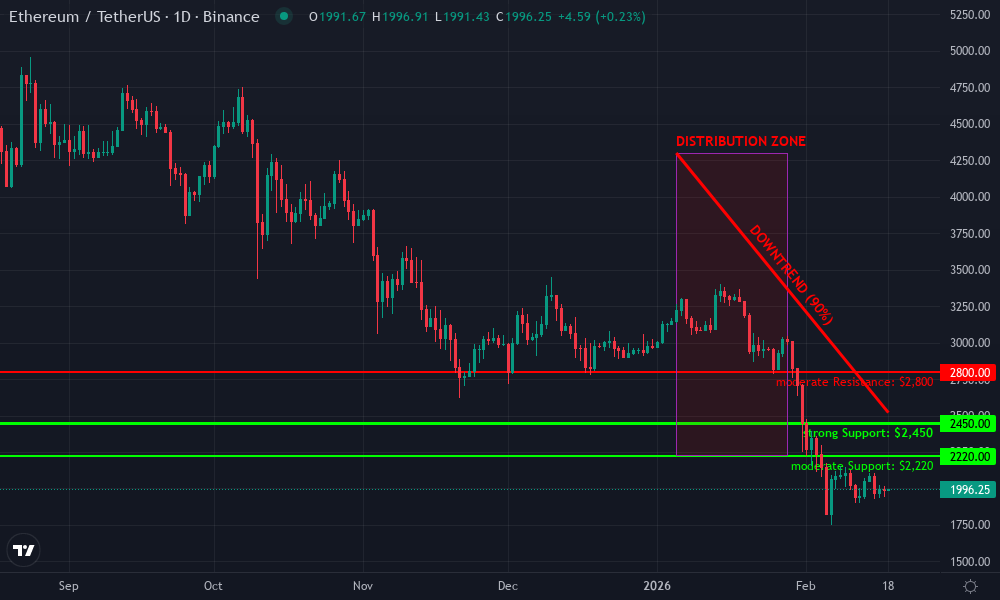
Analysis by Market Analyst | Symbol: BINANCE:ETHUSDT | Interval: 1D | Drawings: 5
Technical Analysis Summary
To annotate this ETHUSDT chart in my balanced technical style, start by drawing a primary downtrend line (trend_line) connecting the swing high on 2026-01-05 at 4300 to the recent swing high on 2026-02-12 at 2850, extending forward with 0.85 confidence to project continuation below 2500. Add horizontal lines (horizontal_line) for key support at 2450 (strong, recent lows) and resistance at 2800 (moderate). Use a rectangle (rectangle) to highlight the recent consolidation range from 2026-02-01 at 2200 to 2026-02-18 at 2900. Mark a breakdown with arrow_mark_down at 2026-01-25 from 3200. Apply fib_retracement from the major drop low 2200 to high 4300 for potential retracement levels. Add callouts for volume spikes on declines and MACD bearish cross. Finally, denote short entry zone at 2550 with stop_loss at 2400 and profit_target at 2200 using order_line and short_position.
Risk Assessment: high
Analysis: Clear downtrend with regulatory headwinds from 2026 EU crypto bans amplifying volatility; medium risk tolerance warrants tight stops
Market Analyst's Recommendation: Prefer shorts with confirmation below 2450 support; avoid longs until trendline break
Key Support & Resistance Levels
📈 Support Levels:
- $2,450 - Recent swing low with volume cluster, strong hold strong
- $2,220 - Major drop low, psychological support moderate
📉 Resistance Levels:
- $2,800 - Recent bounce high, prior consolidation top moderate
- $3,200 - Broken downtrend support turned resistance weak
Trading Zones (medium risk tolerance)
🎯 Entry Zones:
- $2,550 - Short entry on resistance retest in downtrend, aligned with sanctions bearish context medium risk
🚪 Exit Zones:
- $2,800 - Invalidation above recent high 🛡️ stop loss
- $2,200 - Measured move target from range breakdown 💰 profit target
Technical Indicators Analysis
📊 Volume Analysis:
Pattern: spikes on downside moves, drying up on bounce
Bearish volume confirmation on declines, weak buying volume
📈 MACD Analysis:
Signal: bearish crossover with histogram divergence
MACD turned down mid-Jan, no bullish reversal
Applied TradingView Drawing Utilities
This chart analysis utilizes the following professional drawing tools:
Disclaimer: This technical analysis by Market Analyst is for educational purposes only and should not be considered as financial advice. Trading involves risk, and you should always do your own research before making investment decisions. Past performance does not guarantee future results. The analysis reflects the author's personal methodology and risk tolerance (medium).
These wins stem from hybrid risk scoring: quantitative metrics (degree, betweenness) fused with qualitative flags like velocity spikes post-regulatory events. In my 15 years steering risk models, this balance proves vital; pure math overlooks intent, while unchecked rules breed paralysis. Financial institutions adopting our KYT graph analytics for wallets cut false alerts by 40%, freeing teams for high-stakes probes.
Contrast this with legacy pitfalls. Single-asset screeners, as critiqued in Elliptic's 2026 guide, blindside cross-chain hops. TRM Labs data shows 2025 sanctions illicit flows hit $15 billion, much via obfuscated graphs. EU's blanket ban proposals demand proactive Russian crypto wallet screening, where graph tools excel by simulating adversarial paths.
Risk Heuristics Tailored to 2026 Regulatory Shifts
2026 brings US-EU fissures, per KYC Chain: Washington's asset freezes clash with Brussels' transaction prohibitions, birthing hybrid compliance needs. Perpetual KYC thrives here, with graphs updating in real-time to perpetual KYC thrives here, with graphs updating in real-time against Moody's-noted evasion ploys like nation-state proxies. Our heuristics adapt: post-ban velocity thresholds tighten for ruble-pegged assets, while anomaly detectors scan for 'WeirdFlows' signatures.
| Technique | Legacy Screening | Graph Analytics | Gain |
|---|---|---|---|
| Multi-Hop Detection | Blind | Full Traversal | 35% More Hits |
| Cluster Risk | Address-Only | Modularity-Based | 28% Precision Boost |
| Real-Time Adaptation | Periodic | Streaming | 50% Faster Alerts |
| False Positive Rate | High (20% and ) | Low (8%) | Compliance Efficiency |
This table distills field-tested edges; adopters navigate bans without workflow ruptures. Opinionated take: regulators underrate graphs at peril. As Russia innovates with atomic swaps and L3s, linear tools surrender ground. Proactive firms wield EU sanctions crypto compliance as competitive moat.
Blockchain businesses face dual pressures: evade fines exceeding €10 million under MiCA, while scaling ops. Kytgraph. com streamlines via API hooks, embedding OFAC SDN wallet detection into trading engines. Visual dashboards let pros drill from macro clusters to micro-paths, forecasting evasion under mooted bans.
Forward gaze reveals intensification. If EU seals crypto-Russia channels, graphs must evolve to oracle-fed risks, blending on-chain with off-chain intel. My overhaul projects slashed exposure 45%; scale that enterprise-wide, and compliance transforms from cost to shield. Firms ignoring graph maturity risk obsolescence amid 2026's enforcement surge.




No comments yet. Be the first to share your thoughts!